Civil society representatives participate in monitoring Serbia’s Reform Agenda, submit independent findings and receive responses from institutions. Their engagement has helped bring the issue of access to documents into focus, but no binding procedure guarantees a response to every finding. The central question remains how independent assessments are considered when decisions are made on reforms and EU funding.
Under the European Union’s Growth Plan for the Western Balkans, Serbia has committed to implementing reforms on which access to EU financial assistance depends. These commitments are set out in Serbia’s Reform Agenda, while the country submits payment requests to the European Commission reporting on the implementation of reform steps.
Civil society organisations also participate in monitoring this process through the National Convention on the European Union (NCEU). Their independent monitoring involves analysing reform commitments, legislation, institutional reports and available evidence.
Under the methodology explained by Milena Mihajlović Denić, each reform step is assessed against the obligation set out in the Reform Agenda. Where evidence of fulfilment is not publicly available, the NCEU assesses the step as unfulfilled because its implementation cannot be verified.
Dijalog Net spoke about these issues with Gentiola Madhi, a policy researcher at OBC Transeuropa focusing on regional cooperation and European integration in the Western Balkans, and Milena Mihajlović Denić of the European Policy Centre (CEP), who serves on the Reform and Growth Facility Monitoring Committee as an NCEU representative and coordinates the Intersectoral Working Group for Monitoring the Implementation of Serbia’s Reform Agenda (MRG RA), which prepares independent monitoring reports.


Photo: Viktor Ljevar
A seat at the table: The right to speak, but no obligation to respond
Civil society participation is envisaged under the EU framework governing the Reform and Growth Facility, established by Regulation (EU) 2024/1449. The rules for implementing financial assistance to Serbia are further governed by an agreement between the European Union and the Republic of Serbia.
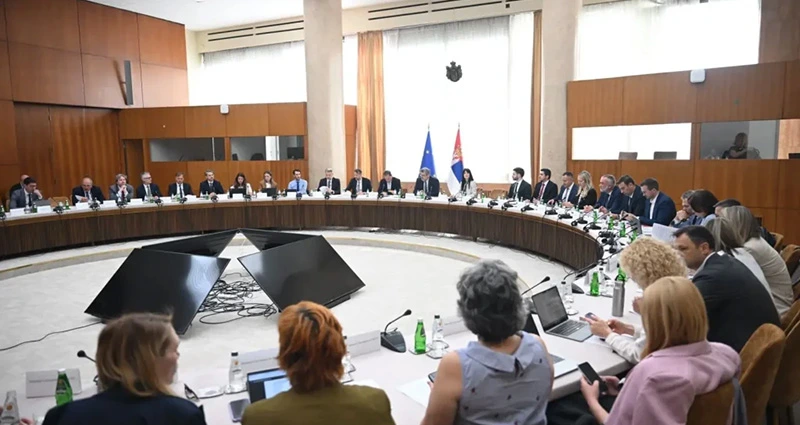
One of the monitoring mechanisms is the Monitoring Committee, which includes an NCEU representative. Its work is documented, among other sources, in the operational conclusions of the Committee’s first meeting.
Milena Mihajlović Denić emphasises that the NCEU representative is not merely an observer but a permanent member of the Committee. Civil society participates in discussions, receives documents and expresses views on reform steps.
According to her account of the Committee’s rules, decisions are taken by consensus or, where consensus cannot be reached, by agreement between the two co-chairs: the Minister of European Integration and a European Commission representative. Civil society representatives can submit proposals and written requests.
Gentiola Madhi, who approaches European integration from a regional perspective, points out that meaningful participation requires more than formal presence. Among the important conditions she identifies are transparent selection of representatives, appropriate rights to participate in discussions and decision-making, timely access to documents, and reasoned institutional responses to submitted comments.
Madhi also distinguishes the time-limited monitoring mechanism under the Reform and Growth Facility from the need for more permanent institutional dialogue with civil society within the broader European integration process.
For the NCEU, however, the main limitation of the existing mechanism is not a demand that civil society itself should decide on reforms. The problem is the absence of a procedure requiring institutions to provide a formal, reasoned response to every finding of independent monitoring.
More documents are available, but not everything needed for verification
One concrete improvement in transparency is the public release of the payment requests Serbia submits to the European Commission to obtain financial assistance.
The Ministry of European Integration began publishing payment requests, making the Government’s claims about the implementation of reform steps publicly available.
Milena Mihajlović Denić links this development to earlier NCEU advocacy. According to the chronology she provides, publication was requested at the Monitoring Committee’s first meeting in October 2025, and the request was repeated at trilateral meetings in December of that year and on 13 May 2026.
She says the Ministry undertook at the May meeting to propose a method of publication, that publication was announced on 27 May at an MRG RA meeting, and that the requests became publicly available before the Monitoring Committee meeting on 3 June 2026. According to her, the European Commission welcomed this development.
For the NCEU, the most important outcome was what publication made possible: comparing the Government’s claims with the evidence, step by step.
According to Mihajlović Denić, independent monitoring identified nine reform steps worth a total of €156 million that the Government presented as fulfilled, while the NCEU considers that the available evidence does not demonstrate their fulfilment.
The publication of payment requests has not resolved the problem of access to all relevant information.
Mihajlović Denić says NCEU representatives receive meeting materials, the Government’s annual report, agendas and draft minutes, but do not have access to all the documents used in exchanges between the Government and the European Commission.
She points in particular to Commission assessments of whether reform steps have been fulfilled, certain opinions on draft legislation, evidence supporting Government claims, and some information on the results of measures taken.
According to her figures, at the end of July 2026, 40 reform steps worth a total of €625 million were awaiting Commission assessment.
In Serbia’s fourth payment request, dated 15 July 2026, the Government reports on the implementation of reform steps for which it seeks financial assistance. The European Commission decides whether the conditions for the release of funds have been met.
For independent monitoring, access to the documents supporting claims about reform implementation, as well as institutional reasoning, is essential.
When institutions respond, what actually changes?
NCEU participation has not been limited to submitting comments without institutional communication.
According to Milena Mihajlović Denić, the competent authorities responded to all 25 written comments submitted by the NCEU following a trilateral technical meeting held in December 2025.
According to Milena Mihajlović Denić, the responses were provided in a single consolidated written document. Mihajlović Denić explains that a written procedure exists and that the NCEU receives responses in many cases, although certain requests have remained unanswered.
In her assessment, the central limitation is the absence of a binding procedure that would turn every independent monitoring finding into a matter requiring a formal institutional response.
She also points to the implementation of earlier recommendations. According to figures from the NCEU’s second report, none of the 16 recommendations in the first report had been fully implemented, seven had been partly implemented, eight had not been implemented, and one could not yet be assessed.
A particularly illustrative example is Article 41a of the Government’s Rules of Procedure.
According to Mihajlović Denić, the Reform Agenda required amendments to the Government’s Rules of Procedure to strengthen public consultation procedures. However, amendments adopted in November 2025 introduced a new exception to holding public consultations, contained in Article 41a.
The NCEU therefore assesses the reform step as unfulfilled. She also states that SIGMA/OECD issued a predominantly negative opinion on the provision.
According to her, the Government rejected the assessment that public consultation standards had been weakened but announced that the issue would be discussed further in a working group involving civil society. Mihajlović Denić says the working group did not meet during 2026.
She adds that the Government’s General Secretariat prepared a draft amendment that would delete Article 41a, but that the amendment was not adopted. According to her information, the draft was not made public or subjected to consultations, while the Commission, according to statements by the General Secretariat that she recounts, issued a favourable opinion in early July.
Mihajlović Denić states that Article 41a remains in force and that the Government presents the reform step as fulfilled in its fourth payment request.
According to the interviewee’s account, institutional communication took place, but the change the NCEU considers necessary was not implemented.
When an independent finding receives no formal response
Another important example concerns the publication of contracts concluded under intergovernmental agreements.
The Reform Agenda requires the publication of contracts concluded under international agreements, starting in December 2024.
In Serbia’s fourth payment request, under *Fiche No. 5*, the Government describes the publication of basic information about projects and presents the reform step as fully fulfilled.
Mihajlović Denić explains that the NCEU disputes this assessment because publishing basic information about projects is not the same as publishing the contracts themselves and their annexes.
According to her, the MRG RA prepared a written analysis of this reform step in December 2025 and submitted it to Monitoring Committee members. She says no formal response to that analysis was received.
She also reports that, at the Monitoring Committee meeting on 3 June 2026, the Government stated that the Commission had given the reform step a preliminary positive assessment.
According to her figures, €20.4 million is associated with this reform step.
Independent NCEU reports are prepared in line with payment-request cycles and submitted to Monitoring Committee members so that their findings can be considered before final decisions are taken.
When a documented objection receives no formal response, it remains unclear whether the competent institution accepted, rejected or otherwise assessed the civil society argument.
The final link: Can influence be demonstrated?
On 12 January 2026, the European Commission adopted Implementing Decision C(2026) 18 final on the first release of funds to Serbia.
This decision preceded the NCEU’s first independent monitoring report on the Reform Agenda, which was presented in May 2026. It therefore cannot be used to assess the influence of findings contained in that subsequently prepared report.
This does not exclude the possibility that the Commission had previously considered other information or contacts with civil society.
According to the information available to Milena Mihajlović Denić, no further formal European Commission decision on a payment has been adopted since that decision.
Mihajlović Denić identifies the limited visibility of how institutions act on independent findings as one of the greatest weaknesses of the existing monitoring system.
In her assessment, independent monitoring is meaningful if the institution deciding on financial assistance considers the findings and publicly explains whether it accepts them and why.
She says the NCEU therefore calls on the Commission to explain its assessments of reform steps against the obligations set out in the Reform Agenda, and for a new trilateral meeting to be held before the relevant deadlines in December 2026 and 2027.
Madhi approaches the same problem from a broader regional perspective. In her view, meaningful participation requires more than institutions inviting civil society to consultations. It must also be possible to track what happened to the comments submitted and how they influenced final documents and decisions.
Serbia’s experience so far shows that formal civil society participation can be associated with concrete improvements: more publicly available documents, direct communication with institutions and responses to certain comments.
To assess the impact of independent monitoring reliably, the institutions making decisions must make relevant evidence accessible and clearly explain how they have considered independent findings.
The question, therefore, is not simply whether civil society has a seat at the table in monitoring reforms, but whether the institutions making decisions enable the public to see which findings have been accepted, which have been rejected, and for what reasons.
Srpska verzija:
Pročitajte tekst na srpskom jeziku